
New Mexico Residents Directory Search Steps
New Mexico has no one statewide resident list. The state provides voter services, vital records, licensing tools, archives, and a court case index; county offices keep the parcel, deed, election, probate, and many local files. Start with the county tied to the address, because property data and deed indexes do not sit in one statewide portal. A name-only search across New Mexico is broad, especially where surnames and street names repeat. A New Mexico residents directory search works best when you narrow the county first.
Use official records to test a lead, not to assume a person lives at a place today. An assessor record names an owner, while a voter file can be stale or protected and a directory entry reflects one year. A stronger match joins a name, place, and time from separate sources.
- Pin down the county and search its assessor or treasurer by name, address, or parcel.
- Compare the result with New Mexico voter status or a public county voter-file request, respecting protected fields.
- Check the county clerk's deed index when ownership or a past address needs proof.
- For an older household, look for a city directory, newspaper, census, or archive entry from the right year.
- If a public record is not online, ask the named custodian about counter, phone, mail, or IPRA access.
Where New Mexico Records Are Kept
New Mexico divides record keeping between state agencies and 33 county systems. The county clerk records real-property instruments; each assessor maintains local parcel data, and the Secretary of State and county clerks handle separate election functions. A state-level archive may hold older transferred records, but it is not a single deed index for every county.
This New Mexico reference often leads to two different offices: one that indexes a record and another that can certify a copy. Use the state custodian for statewide files and the county or court named in a record for local material. When a portal shows only a summary, ask its office what counter, registered, mail, or request route provides the underlying record.
State Records Center and Archives
State agency records and historical finding aids
New Mexico statewide collections
NM Health Vital Records
State birth and death certificates
Eligibility, ID, mail, and fees apply
Secretary of State Elections
Voter status and statewide election records
County clerks handle local files and forms
Finding Counties for New Mexico Records
New Mexico has 33 counties, and the county matters more than a mailing city for parcel and deed searches. County clerks record real-property instruments, while each county assessor holds its own parcel data. New Mexico Taxation and Revenue sends property questions to the county assessor rather than offering one statewide parcel lookup. A city name, ZIP label, or rural post office can cross a county or municipal line.
Use the full address to find its county, then check the assessor and clerk that serve that land. Around Albuquerque, the Bernalillo Planning and Development Services address atlas is a source for official address assignments in the unincorporated county. Its map is a reference, not a survey or legal description. Santa Fe and Doña Ana use their own county portals and rules.
New Mexico Property Search Fields
The Bernalillo County Treasurer's real-property search accepts an address or parcel query and a tax-year filter. A street-only search can return addresses along that street; the county advises omitting the street suffix for a better match. The parcel ID field accepts an asterisk wildcard for groups or prefix/suffix patterns. Search results were unavailable during the research inspection, so no unobserved parcel-card fields are promised here.
The Bernalillo public property search screen shows the address, parcel, year, and sort controls used for a query.
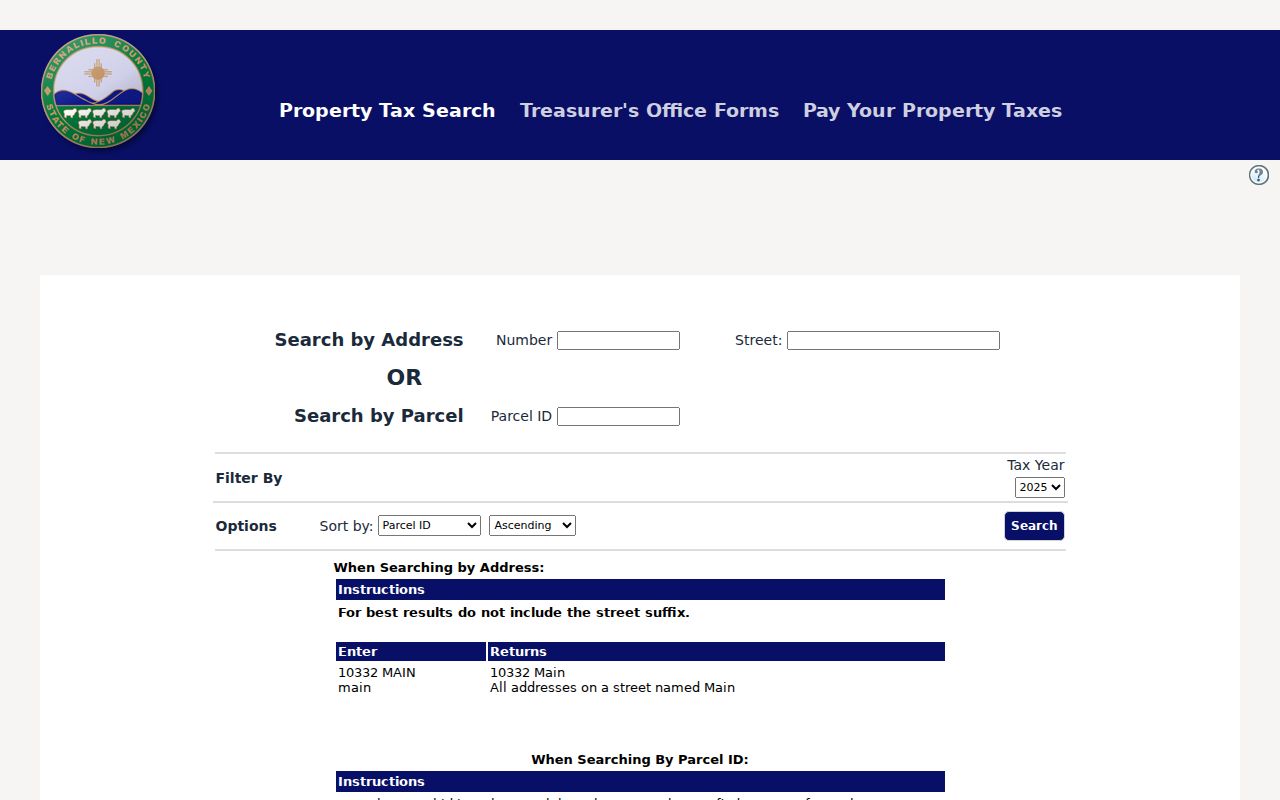
Use this county example to see how a parcel search begins, then confirm the owner and property details with the assessor. Each New Mexico county may label its fields differently.
| Search control | Type | Required | What the county documents |
|---|---|---|---|
| Number | Text | Optional with Street | Street number, for example 10332 |
| Street | Text | Optional with Number | Street suffix may be omitted; a street-only query returns matching addresses |
| Parcel ID | Text | Optional alternative | An asterisk searches a group or prefix/suffix pattern |
| Tax Year | Dropdown | Optional | Available years change |
| Sort by / Search | Control / button | No | Sort options are dynamic; Search submits the query |
New Mexico Residents Directory Source Types
Current New Mexico resident information is split across records with different purposes. A parcel roll centers on an owner and a property, a voter record supports election administration, and a court index describes a case. A directory, obituary, or yearbook can add a historical address or affiliation. No row below is a full list of the people in a household.
| Record source | What it can show | Keeper | Access route |
|---|---|---|---|
| Assessor or tax account | Owner, parcel, situs and mailing addresses, values or tax-year clues | County assessor or treasurer | County portal or counter; fields vary |
| Recorded-document index | Deed parties, instrument dates, liens, and conveyance clues | County clerk | County index, image portal, terminal, or request |
| Voter information | Public registration fields and election participation, with protected data removed | Secretary of State and county clerk | Personal status tool or county-file request |
| Public court index | Case number, party, filing, case type, and status or disposition when shown | New Mexico Courts and court clerk | Online summary; documents use separate access routes |
| Historical directory or yearbook | A person, household, address, or affiliation in a named year | Library, archive, or school collection | Catalog, reference desk, microfilm, or licensed access |
Choose a source by the question. The assessor is the place to start with a parcel; a county clerk is the source for a recorded deed; a public case search is not a court file. For one person, the New Mexico resident lookup explains how to compare sources without treating one name match as proof.
Looking Back Through New Mexico Directories
Albuquerque's cataloged directory holdings include selected Gale microfilm years from 1955-1956 through 1978; this is not a complete annual run. The Albuquerque Special Collections and Genealogy Center guide points to phone books and city directories, while UNM's Center for Southwest Research holds maps, manuscripts, newspapers, and other local-history material. Ask the reference desk which volume is present before making a trip.
A printed directory can place a named person or household at an address for one year. It does not prove who lives there now, and older city limits or street names may differ. The New Mexico city directory collections page covers the surviving runs and ways to read them.
Santa Fe Clerk Records in New Mexico
Santa Fe County provides a documented example of online and counter access to recorded instruments. Its ClerkTrackWeb portal separates index search from document purchase, uses PUBLIC/PUBLIC for public access and INDEX/INDEX for the index route, and can email purchased images. If the index search and pickup route is used, the clerk asks for two business days after the instrument number is found.
The clerk says more than 480,000 records have been digitized since 2021. Foyer computers are free during business hours. Staff address or chain-of-title research costs $40 for the first 15 minutes and $40 per hour after that; the result is unofficial and not guaranteed. The Santa Fe County ClerkTrackWeb public portal shown below provides the search interface; the Clerk's public-record access page describes this county's other routes.
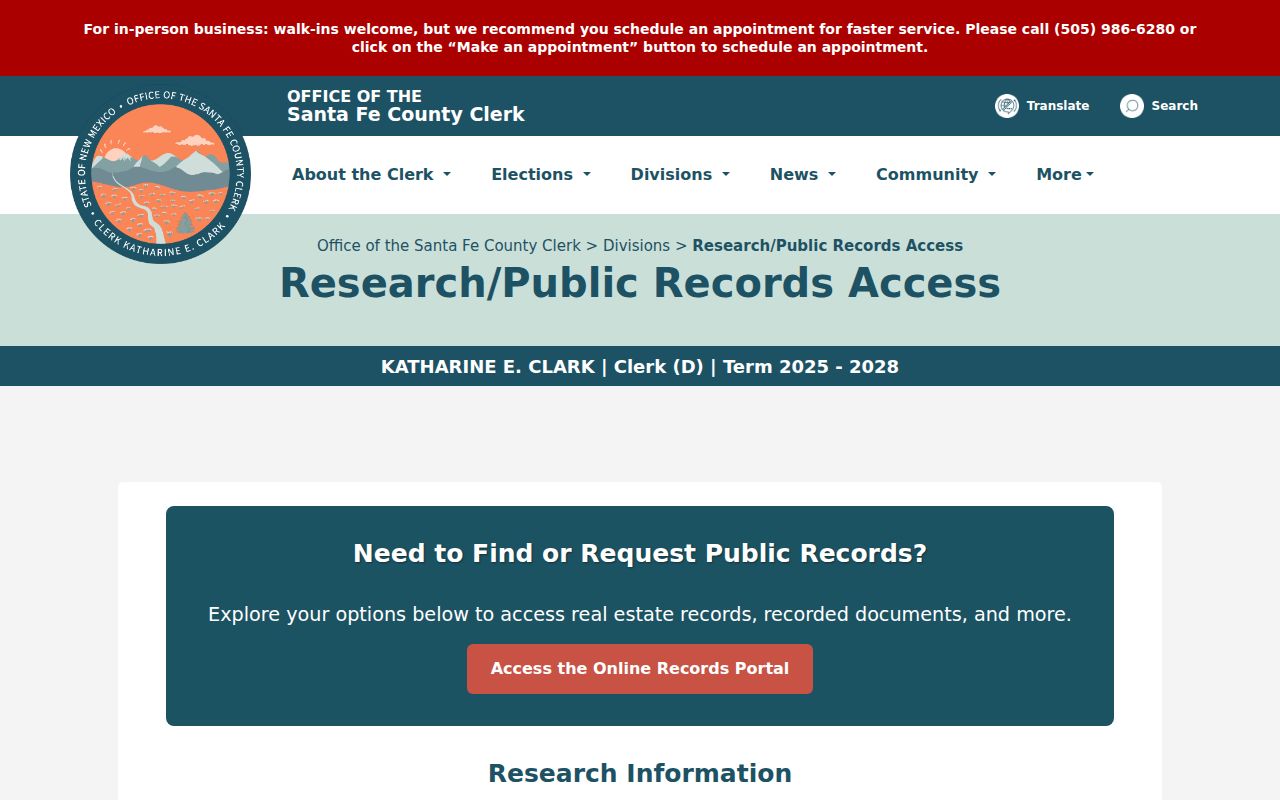
Those terms belong to Santa Fe County and should not be assumed for another New Mexico clerk. Compare each county's search, copy, and research rules.
New Mexico Voter Records
The Secretary of State's My Registration Information tool lets a voter check registration and voting-location details. Separately, a public-record request can reach county voter-file fields after a registration is accepted. A public file may show a registered address, party, status, precinct or district, registration date, and whether a person voted in an election. It does not show ballot choices. A New Mexico residents directory search should treat this as an election record, not a list of every person at an address.
Day and month of birth and the Social Security number are protected. Safe at Home and related voter protections can substitute or shield a residential address. The online registration identity fields were not exposed in the text review, so use the Secretary of State's current form and ask the county clerk for public-file details.
The New Mexico voter-status service is shown below as a self-service route, not a public household list.
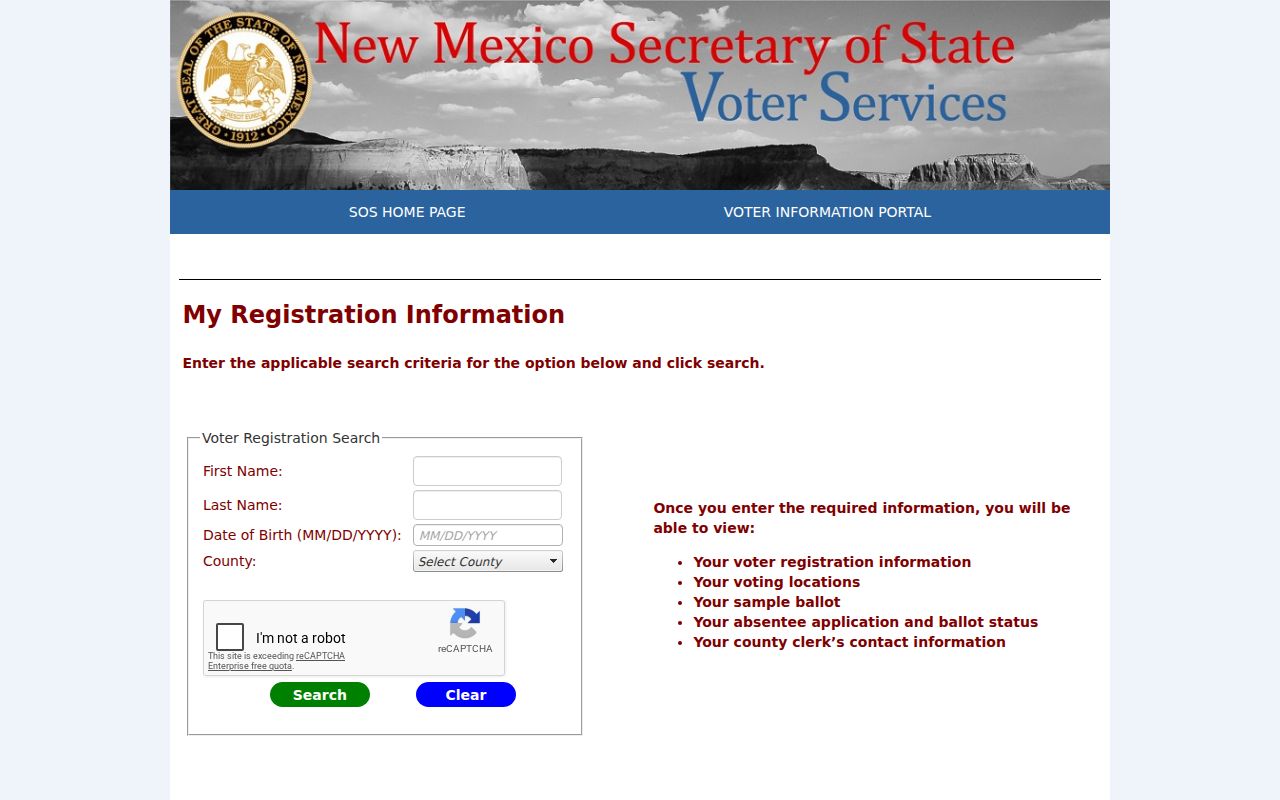
Ask the county clerk for the current public-file format, fee, and redactions before requesting a list.
| Field or feature | Type | Required | Official notes |
|---|---|---|---|
| Name/registration identity | Online lookup input | Not exposed in text inspection | Status tool is the NM SOS My Registration Information route |
| Registered address | Result field | n/a | Used to determine precinct and ballot; voter must update after moving |
| Party affiliation | Result/registration field | n/a | Party choice optional; DTS/No Party exists; public registration may show party |
| Registration status | Result field | n/a | Active/inactive/cancelled maintenance status may apply |
| Precinct/districts | Result field | n/a | Ballot contests derive from physical registration address |
| Voting location | Result/tool output | n/a | Voter services returns where to vote |
| Birth day/month and SSN | Protected field | n/a | SOS says always privacy protected |
| Ballot choice | Never public | n/a | Vote choices are secret |
New Mexico Court Case Records
New Mexico Courts' public Case Lookup covers appellate, district, magistrate, metropolitan, and municipal court records. A result may identify the case number, court, parties, case type, filing or docket dates, and status or disposition when shown. Treat a name match as a lead; a docket entry alone does not prove identity, current address, or the truth of an allegation.
Basic internet search provides a summary, not the filed document set. Records before 1997 require an online request, and personal identifiers such as SSN and address are withheld. Public municipal data is limited to historical domestic-violence and DWI criminal convictions from September 1, 1991; juvenile criminal cases are omitted from July 1, 2007, and domestic-violence protection-order cases from July 1, 2008. A registered re:SearchNM profile, courthouse public-access terminal, or clerk request may be needed for more.
- Case number
- The court's identifier for the case.
- Party and role
- The name and, where exposed, whether the person is a plaintiff, petitioner, defendant, or respondent.
- Docket
- A dated list of filings or actions in the case.
- Disposition
- The outcome or case status, when the result displays one.
Restricted New Mexico Birth Records
A certified New Mexico birth certificate is not a general online lookup. NM Health limits copies to named immediate family or a requester with tangible proof of legal interest. The application asks for the applicant's details and relationship, the registrant's birth name and date, New Mexico place of birth, parents' names, government photo ID, payment, purpose, and signature.
The form states a $10 search or certificate fee and an average 6-12 week processing time. Mail it to New Mexico Vital Records and Health Statistics, PO Box 25767, Albuquerque, NM 87125; the listed phone is 1-866-534-0051. A sibling or grandparent must supply relationship proof, and a non-immediate relative needs legal-interest documents. The official rule on when older certificates become open was not located, so no age cutoff is stated. Church, cemetery, newspaper, census, and archive sources may supply historical clues, but they do not replace eligibility for a certified copy.
Use the NM DOH Vital Records route for current forms and submission instructions. Marriage applications follow county-clerk procedures; divorce files belong to the district court.
New Mexico Deed Records
Each county clerk records deeds, mortgages, liens, releases, and other instruments for that county. New Mexico has no single statewide deed index. A recorded deed identifies parties and property details for a transaction, but it traces ownership rather than every person who lived in the home. Older paper books, microfilm, counter terminals, email retrieval, and staff research may fill gaps left by an online index.
Search the county by grantor and grantee, the people or entities transferring and receiving an interest. Note the instrument number, recording date, and legal description, then use that identifier to request an image or certified copy. When a street or parcel name has changed, compare the lot, block, subdivision, and map. Do not treat a deed as proof of current residence.
New Mexico Public Record Requests
When a New Mexico agency has a public record that is not online, the Inspection of Public Records Act (IPRA), NMSA 1978 §§14-2-1 through 14-2-12, is the request route. A person need not explain why they want to inspect a public record. Send the request to the custodian for the agency that holds it, not to a different county office or to this reference.
Give the custodian enough detail to find an existing record. A request does not make an agency create a new list or answer a research question. A written denial must state its reason, and restricted records such as a birth certificate use their own application process rather than IPRA.
- State your name, address, and telephone number.
- Describe the record, county or office, address or name, and date range with reasonable detail.
- Ask for inspection or a usable copy format; narrow the request if it covers too many files.
- Track the response. If records are not available within three business days, the custodian must explain when it will respond; the ordinary outside period is 15 calendar days.
For pages no larger than 11 by 17 inches, the Act caps copy charges at $1 per page and allows advance payment. A custodian may apply a lawful exception or give more time for a broad request.
Protected New Mexico Resident Addresses
Safe at Home, run by the Secretary of State, gives eligible survivors of domestic violence, sexual assault, attempted sexual assault, or stalking a substitute mailing address and a way to take part in voting without ordinary residential-address exposure. The application must be completed with an application assistant and includes identity and safety information. The packet covers participants who have moved within the prior 90 days or plan to move within 90 days.
The program forwards first-class mail using an authorization number. Private companies do not have to accept the substitute address, and release of the residential address is limited, with a court-order exception. An address that appears blank or different in a public record may reflect a protection rule, not a missing record. Do not try to uncover a protected residence through other people or services.
Use public records for lawful personal research. Never use a name or address to stalk, harass, threaten, or expose another person.
New Mexico Unclaimed Property Records
The state Taxation and Revenue Department offers a free search and claim route for unclaimed property. A name or former address can be a useful family-history lead, but a listing does not by itself establish identity or a current home. Review the claim requirements at the official state source and do not pay a caller who claims that a public claim needs an upfront recovery fee.
In July 2024, the department warned about a solicitation targeting an older resident and directed people to search through the state's own service. The New Mexico Taxation and Revenue site links to the official search. Save a notice and verify any claim number using the state website or contact details listed there.
Official record
Created and held by a named public custodian. Check its fields, date, and access limits, then ask that custodian to confirm a result.
Commercial data tool
May combine feeds and brokered material. Results can be stale, mismatched, paywalled, or hard to correct; use the original office for verification.
Limits on New Mexico Resident Matches
Public access does not mean every person or field appears in a search. Assessor rolls focus on owners, not all household members. Voter fields omit protected birth and address details; courts hide identifiers and some case types; birth copies have eligibility rules. County portals differ, and older records may live in a library, archive, paper book, or clerk's office rather than online. A New Mexico residents directory is a set of routes, not a census of every home.
New Mexico searches also need local spelling and place variants. Try a full and shortened street form, a prior surname, and the county or post-office name that fits the record's year. Keep the source and date beside each result. If a match matters, check it with the custodian instead of treating a search summary as proof.