
New Mexico Residents Directory Search Steps
No single statewide list covers every New Mexico household. The state runs voter services, vital records, licensing tools, archives, and a court case index. Counties keep the parcels, deeds, probate files, and local election records. Start with the county tied to the address. Property data and deed indexes never sit in one statewide portal. A name-only search across New Mexico gets broad fast. It spreads quickest where surnames and street names repeat. Narrowing the county first is what makes a New Mexico residents directory search work.
Test a lead with official records instead of assuming someone still lives at a place today. An assessor entry names an owner. A voter file can be stale or protected. A directory entry reflects one year only. The strongest match ties a name, a place, and a time together using separate sources.
- Pin down the county and search its assessor or treasurer by name, address, or parcel.
- Compare the result with New Mexico voter status or a public county voter-file request, respecting protected fields.
- Check the county clerk's deed index when ownership or a past address needs proof.
- For an older household, look for a city directory, newspaper, census, or archive entry from the right year.
- If a public record is not online, ask the named custodian about counter, phone, mail, or IPRA access.
Where New Mexico Records Are Kept
Record keeping in New Mexico splits between state agencies and 33 county systems. County clerks record real-property instruments. Each assessor maintains its own parcel data. The Secretary of State and county clerks run separate election functions. A state archive may hold older transferred records. But it is not one master deed index for every county.
This directory reference often points to two different offices. One indexes a record; another certifies a copy. Use the state custodian for statewide files. And use the county or court named in a record for local material. When a portal shows only a summary, ask its office a simple question. Which counter, mail, or request route gets you the underlying record from the records office?
State Records Center and Archives
State agency records and historical finding aids
New Mexico statewide collections
NM Health Vital Records
State birth and death certificates
Eligibility, ID, mail, and fees apply
Secretary of State Elections
Voter status and statewide election records
County clerks handle local files and forms
Finding Counties for New Mexico Records
New Mexico has 33 counties, and for parcel and deed searches the county matters more than the mailing city. Clerks record the deeds. Each assessor holds its own parcel data. New Mexico Taxation and Revenue sends property questions back to the county assessor rather than running one statewide parcel lookup. A city name, ZIP label, or rural post office can cross a county line.
Find the county from the full address first. Then check the assessor and clerk serving that land. Around Albuquerque, the Bernalillo Planning and Development Services address atlas is the source for official address assignments in the unincorporated county. Treat its map as a reference, not a survey. Santa Fe and Doña Ana each run their own portals with their own rules.
New Mexico Property Search Fields
The Bernalillo public property search screen displays the address, parcel, year, and sort controls a query uses. The Bernalillo County Treasurer's real-property search takes an address or parcel query. It adds a tax-year filter. A street-only search can return every address along that street. The county suggests dropping the street suffix for better matches. The parcel ID field accepts an asterisk wildcard for prefix or suffix patterns. The treasurer publishes no parcel-card fields beyond the query controls described here.
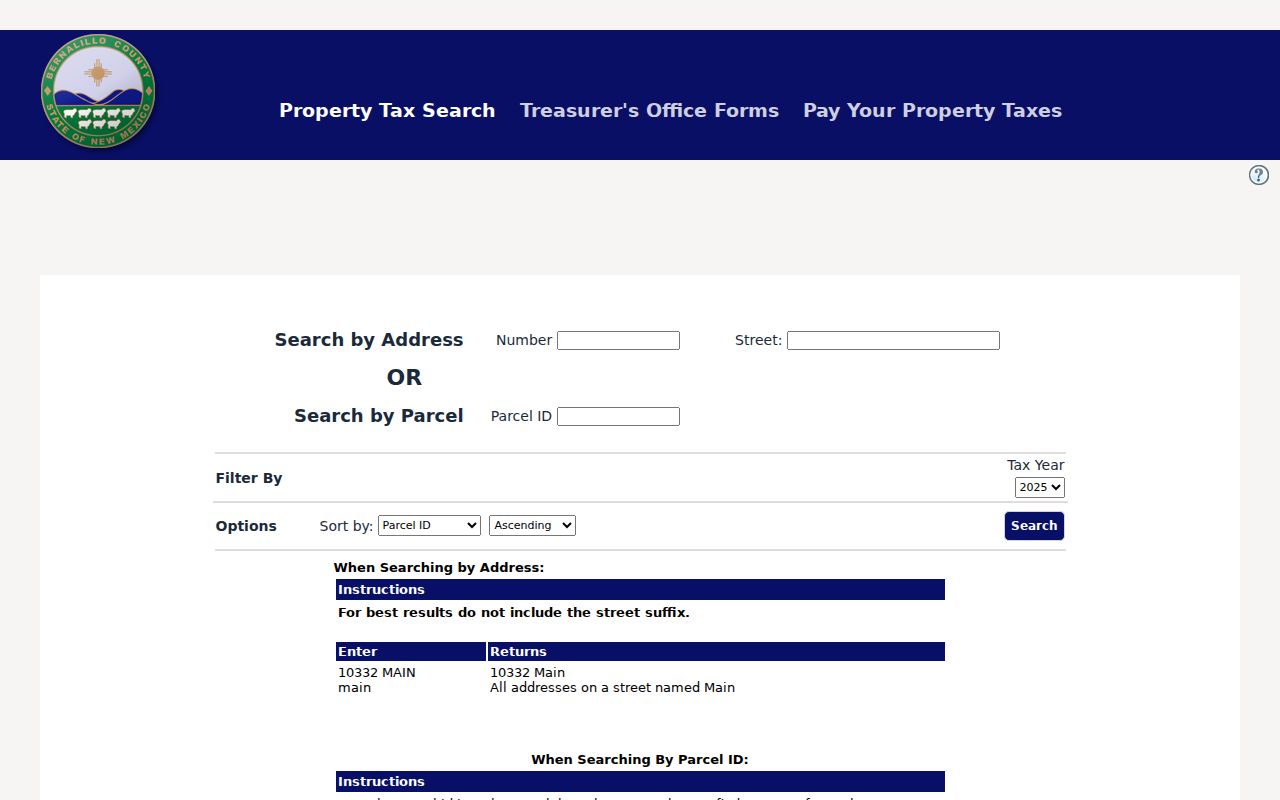
Use this county example to see how a parcel search starts, then confirm the owner and property details with the assessor. Field labels vary from one New Mexico county to the next.
| Search control | Type | Required | What the county documents |
|---|---|---|---|
| Number | Text | Optional with Street | Street number, for example 10332 |
| Street | Text | Optional with Number | Street suffix may be omitted; a street-only query returns matching addresses |
| Parcel ID | Text | Optional alternative | An asterisk searches a group or prefix/suffix pattern |
| Tax Year | Dropdown | Optional | Available years change |
| Sort by / Search | Control / button | No | Sort options are dynamic; Search submits the query |
New Mexico Residents Directory Source Types
Current New Mexico resident information lives in records built for different purposes. A parcel roll centers on an owner and a property. A voter record supports election administration. A court index describes a case. Directories, obituaries, and yearbooks can add a historical address or affiliation. No single row is a full household list.
| Record source | What it can show | Keeper | Access route |
|---|---|---|---|
| Assessor or tax account | Owner, parcel, situs and mailing addresses, values or tax-year clues | County assessor or treasurer | County portal or counter; fields vary |
| Recorded-document index | Deed parties, instrument dates, liens, and conveyance clues | County clerk | County index, image portal, terminal, or request |
| Voter information | Public registration fields and election participation, with protected data removed | Secretary of State and county clerk | Personal status tool or county-file request |
| Public court index | Case number, party, filing, case type, and status or disposition when shown | New Mexico Courts and court clerk | Online summary; documents use separate access routes |
| Historical directory or yearbook | A person, household, address, or affiliation in a named year | Library, archive, or school collection | Catalog, reference desk, microfilm, or licensed access |
Let the question pick the source. Start with the assessor for a parcel. Go to a county clerk for a recorded deed. A public case search is not the court file itself. For tracing one person, the New Mexico resident lookup shows how to compare sources without treating one name match as proof.
Looking Back Through New Mexico Directories
Albuquerque's cataloged directory holdings include selected Gale microfilm years from 1955-1956 through 1978. The run is not complete for every year. The Albuquerque Special Collections and Genealogy Center guide points to phone books and city directories. UNM's Center for Southwest Research holds maps, manuscripts, newspapers, and other local-history material. Ask the reference desk which volume is present before you travel.
A printed directory can place a named person or household at an address. That hold is for one year only. It proves nothing about who lives there now. Older city limits and street names may also differ from today's. The New Mexico city directory collections page covers the surviving runs. It also explains how to read them.
Santa Fe Clerk Records in New Mexico
Santa Fe County shows how a clerk can split index searching from document buying. Its ClerkTrackWeb portal logs in with PUBLIC/PUBLIC for full public access. INDEX/INDEX covers the index route. Purchased images can arrive by email. Take the index-and-pickup route instead. The clerk asks for two business days after the instrument number turns up.
More than 480,000 records have been digitized since 2021. Foyer computers are free during business hours. Staff research into an address or chain of title runs $40 for the first 15 minutes, then $40 per hour. The result stays unofficial and unguaranteed. The Santa Fe County ClerkTrackWeb public portal shown below holds the search screen. The Clerk's public-record access page maps the county's other routes.
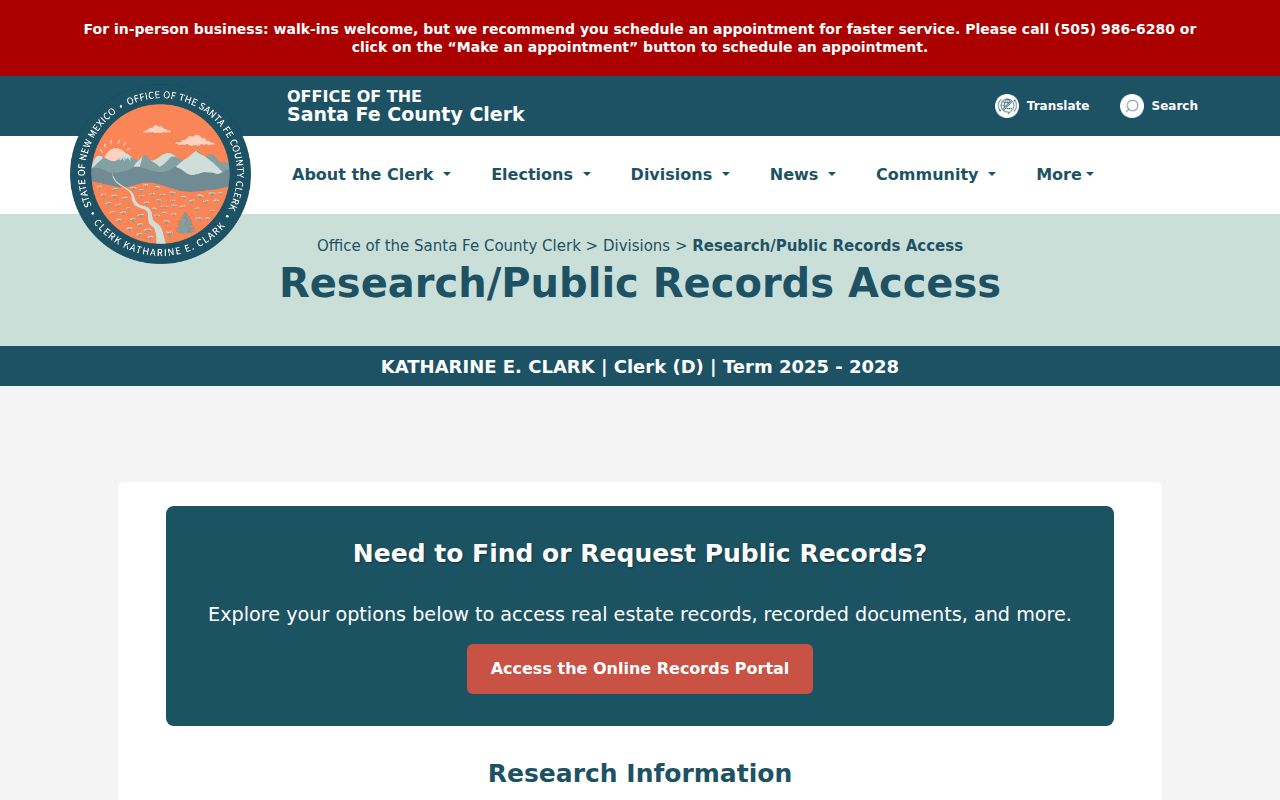
Those terms belong to Santa Fe County alone. No other New Mexico clerk should be assumed to match them. Compare each county's search, copy, and research rules before you rely on one clerk's setup.
New Mexico Voter Records
The Secretary of State's My Registration Information tool lets a voter confirm registration on their own. It also shows voting-location details. A public-record request works differently. Through it, county voter-file fields can be released after a registration is accepted. A public file may list a registered address, party, status, and precinct or district. It may also show registration date and whether a person voted. Ballot choices stay private. Treat the voter roll as an election record. It is not a New Mexico residents directory of everyone at one address.
Some fields are protected. Day and month of birth and the Social Security number never appear. Safe at Home and related protections can substitute or shield a residential address. The Secretary of State's current form is the place to confirm identity fields. The county clerk can explain public-file details.
The New Mexico voter-status service appears below. It is a self-service route, not a public household list.
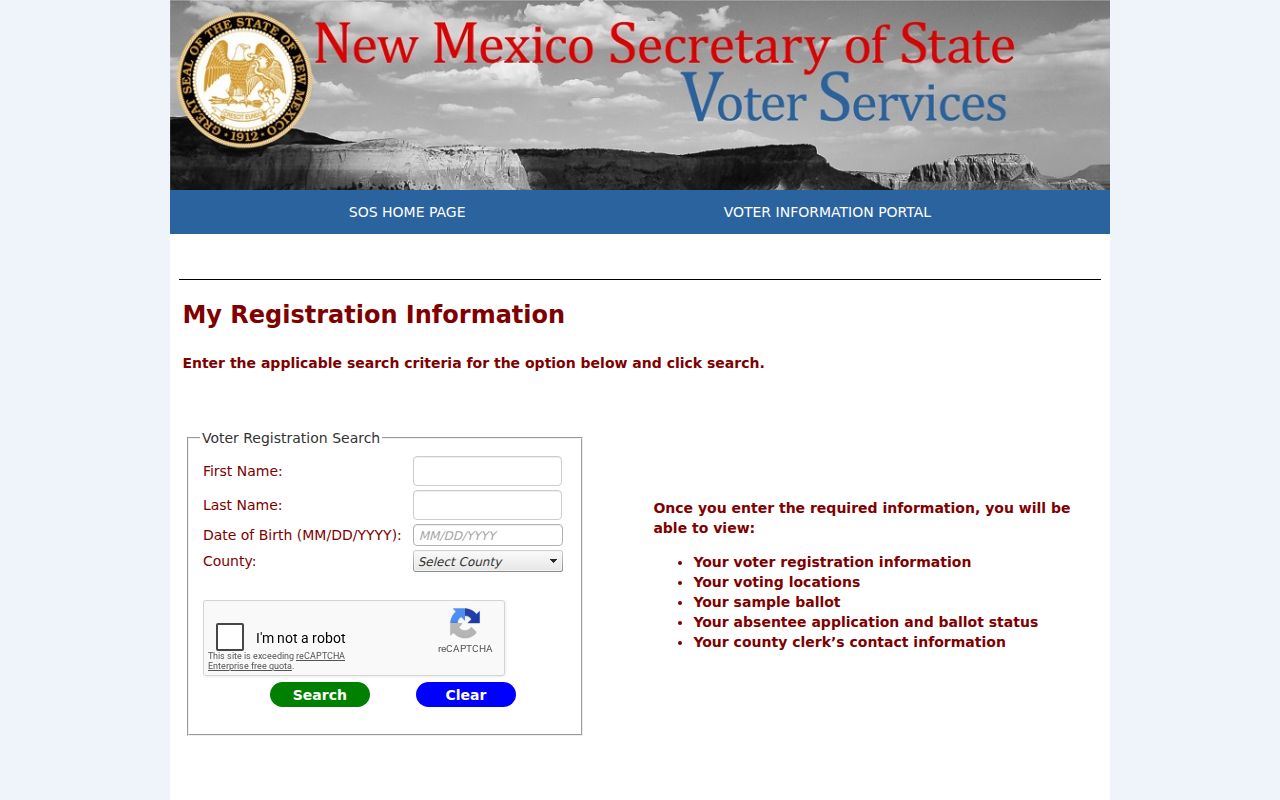
Note: Ask the county clerk about the current public-file format, fee, and redactions before requesting any voter list.
| Field or feature | Type | Required | Official notes |
|---|---|---|---|
| Name/registration identity | Online lookup input | Not exposed in text inspection | Status tool is the NM SOS My Registration Information route |
| Registered address | Result field | n/a | Used to determine precinct and ballot; voter must update after moving |
| Party affiliation | Result/registration field | n/a | Party choice optional; DTS/No Party exists; public registration may show party |
| Registration status | Result field | n/a | Active/inactive/cancelled maintenance status may apply |
| Precinct/districts | Result field | n/a | Ballot contests derive from physical registration address |
| Voting location | Result/tool output | n/a | Voter services returns where to vote |
| Birth day/month and SSN | Protected field | n/a | SOS says always privacy protected |
| Ballot choice | Never public | n/a | Vote choices are secret |
New Mexico Court Case Records
New Mexico's public Case Lookup spans appellate, district, magistrate, metropolitan, and municipal courts. A result can show the case number, court, parties, case type, and filing dates. It also shows status or disposition. Treat any name match as a lead only. A docket entry proves neither identity nor a current address. It does not settle the truth of a claim, either. The lookup returns a summary, not the full set of filed papers.
Records filed before 1997 must be requested online. Personal identifiers, including SSN and address, stay withheld. Public municipal data covers only historical domestic-violence and DWI convictions dating from September 1, 1991. Juvenile criminal cases drop out from July 1, 2007. Domestic-violence protection-order cases drop out from July 1, 2008. For deeper files, you may need a registered re:SearchNM profile. A courthouse public-access terminal works, too. So does a request to the clerk.
- Case number
- The court's identifier for the case.
- Party and role
- The name and, where exposed, whether the person is a plaintiff, petitioner, defendant, or respondent.
- Docket
- A dated list of filings or actions in the case.
- Disposition
- The outcome or case status, when the result displays one.
Restricted New Mexico Birth Records
A certified New Mexico birth certificate is not an open lookup. NM Health restricts copies to immediate family named on the record or to a requester with tangible proof of legal interest. The application asks for the applicant's details and relationship, the registrant's birth name and date, the New Mexico place of birth, and both parents' names. A government photo ID, payment, purpose, and signature complete the form.
The listed fee is $10 for a search or certificate. Processing runs 6-12 weeks on average. Mail the form to New Mexico Vital Records and Health Statistics, PO Box 25767, Albuquerque, NM 87125, or call 1-866-534-0051. Siblings and grandparents must document their relationship. A more distant relative needs legal-interest paperwork. No rule setting an age at which older certificates become open is published, so no cutoff is stated here. Church, cemetery, newspaper, census, and archive records can supply historical clues, though they never replace eligibility for a certified copy.
Use the NM DOH Vital Records route for current forms and submission instructions. Marriage applications go through county-clerk procedures. Divorce files sit with the district court.
New Mexico Deed Records
Each New Mexico county clerk records deeds, mortgages, liens, and releases. No single statewide deed index exists. A recorded deed names the parties and the property. It traces one transaction rather than everyone who ever lived there. Gaps in an online index can be filled by paper books, microfilm, counter terminals, email retrieval, and staff research.
Search grantor and grantee names. Those are the parties transferring and receiving an interest. Jot down the instrument number, recording date, and legal description. That identifier is what you use to request an image or certified copy. Street and parcel names change over time. When they do, compare the lot, block, subdivision, and map before trusting the match. A deed alone is not proof of current residence.
New Mexico Public Record Requests
A record that sits offline in New Mexico still has a route. The Inspection of Public Records Act, NMSA 1978 §§14-2-1 through 14-2-12, opens the door. Anyone can ask. No reason is required. The request goes to the custodian of the agency holding the record rather than to some other county office. Be specific about the record you want, because IPRA covers documents that exist. It does not force an agency to build a new list. It does not answer a research question for you.
Denials must be written and must state a reason. Some records sit outside IPRA entirely, and a birth certificate is one of them. Those use their own application process instead.
- State your name, address, and telephone number.
- Describe the record, county or office, address or name, and date range with reasonable detail.
- Ask for inspection or a usable copy format; narrow the request if it covers too many files.
- Track the response. If records are not available within three business days, the custodian must explain when it will respond; the ordinary outside period is 15 calendar days.
Copying has a price ceiling. For pages no larger than 11 by 17 inches, the Act caps charges at one dollar per page. A custodian may require advance payment. A lawful exception can still apply, and a broad request may earn extra time rather than an instant answer.
Protected New Mexico Resident Addresses
Safe at Home is a Secretary of State program. It shields eligible survivors of domestic violence, sexual assault, attempted sexual assault, or stalking. The program provides a substitute mailing address and a voting route without ordinary residential-address exposure. An application assistant must be part of the process. The packet asks for identity and safety information. It covers moves made within the prior 90 days or planned within 90 days.
First-class mail is forwarded under an authorization number. Private companies can refuse the substitute address. Release of the true residence stays limited unless a court orders otherwise. So a blank or odd address in a public record may reflect protection. It is not a missing entry. Never try to expose a shielded residence through other people or paid services.
Use public records for lawful personal research. Never use a name or address to stalk, harass, threaten, or expose another person.
New Mexico Unclaimed Property Records
Unclaimed property in New Mexico runs through the Taxation and Revenue Department. That office offers a free search and claim route. A name or a former address can spark a family-history lead. A listing alone proves neither identity nor a current home. Read the claim requirements at the official state source. Never pay a caller demanding an upfront recovery fee for a public claim.
In July 2024 the department warned about a solicitation aimed at an older resident. It pointed people back to the state's own service. The New Mexico Taxation and Revenue site links to that search. Save any notice you receive. Verify the claim number through the state website or the contact details printed there.
Official record
Created and held by a named public custodian. Check its fields, date, and access limits, then ask that custodian to confirm a result.
Commercial data tool
May combine feeds and brokered material. Results can be stale, mismatched, paywalled, or hard to correct; use the original office for verification.
Limits on New Mexico Resident Matches
Public access never means every person shows up. Assessor rolls list owners, not every household member. Voter files drop protected birth and address details, courts hide identifiers and some case types, and birth copies carry eligibility rules. County portals vary too. Older records may rest in a library, an archive, a paper book, or a clerk's office instead of online. A New Mexico residents directory is a set of routes, not a census of every home.
Local spelling and place variants matter in New Mexico searches. Try the full street form and the shortened one. Try a prior surname, and use the county or post-office name that fits the record's year. Keep the source and date beside each result. When a match truly matters, confirm it with the custodian rather than trusting a search summary as proof.