
Where New Mexico Directory Collections Survive
The clearest year-by-year evidence found in the research is for Albuquerque and Bernalillo County. Gale's catalog lists selected reels rather than an unbroken annual run. Local library guides identify where phone books and printed directories can be consulted, while the University of New Mexico and other repositories hold maps, newspapers, manuscripts, and related history. Coverage differs by city and collection, so the table marks what is documented and what still needs a local shelf check.
| Collection | Years | Where Held | Access |
|---|---|---|---|
| Albuquerque Gale directory reels | Selected runs: 1955-1956, 1956-1957, 1957, 1958, 1958-1959, 1959-1960, 1960, 1962, 1963, 1965, 1966, 1969, 1970, 1975, 1976, 1977, 1978 | Albuquerque Special Collections and Genealogy Center; Gale microfilm/library holdings; related material at UNM | In-library or licensed access; confirm shelf availability and missing years with staff |
| Albuquerque phone books and reverse directories | Complete run not exposed in the inspected guide | Albuquerque/Bernalillo library guide and local collections | Ask the reference desk for the volume, year, and city boundary |
| New Mexico newspapers | Varies by newspaper title and digitized run | New Mexico Historic Newspapers, Chronicling America, local libraries | Free online where digitized; microfilm or library access varies |
| New Mexico maps and city plans | Albuquerque 1886 and 1898; Santa Fe 1931 and 1936; statewide road map 1933 | UNM Center for Southwest Research and local planning collections | Finding aids, reference service, or local collection access |
| Sanborn fire-insurance maps | City sheets and years vary by place | Library of Congress New Mexico collection and local libraries/archives | Digitized maps or local microfilm |
| Federal census schedules | 1790-1950 schedules released under the 72-year rule | National Archives 72-year rule, FamilySearch catalog, and library databases | Search by census year and enumeration area; place boundaries need checking |
| Church, cemetery, probate, and yearbook collections | Local runs vary; no statewide directory of holdings was located | Parish or cemetery offices, county courts, schools, libraries, and archives | Ask each custodian about years, indexing, and access rules |
The listed Albuquerque years are examples of known cataloged reels, not a claim that every year between 1955 and 1978 survives. A volume's printed year can also cover more than one calendar year. For Santa Fe, Las Cruces, Roswell, Silver City, Farmington, Gallup, Clovis, and smaller places, the research did not establish a complete publisher or year run. Check the city's library or historical collection before assuming that a missing year was never published.
- 1955-1956: the earliest Albuquerque run located in the inspected catalog.
- 1962-1970: selected reels appear in 1962, 1963, 1965, 1966, 1969, and 1970, with gaps.
- 1975-1978: the latest selected Albuquerque runs found in the catalog; later shelf availability was not verified.
New Mexico's Albuquerque Directory Reels
The Albuquerque/Bernalillo library guide is the specific starting point identified for local phone books and directory holdings. New Mexico MainStreet's house-history checklist says Albuquerque volumes are useful for locating the first appearance of an address and points readers to Special Collections and the Genealogy Center. The City of Albuquerque's preservation material also describes the Special Collections Library at Old Main as a source for genealogical information and Albuquerque and Southwest books.
Open Albuquerque's local directory guide before planning a visit or reference request.
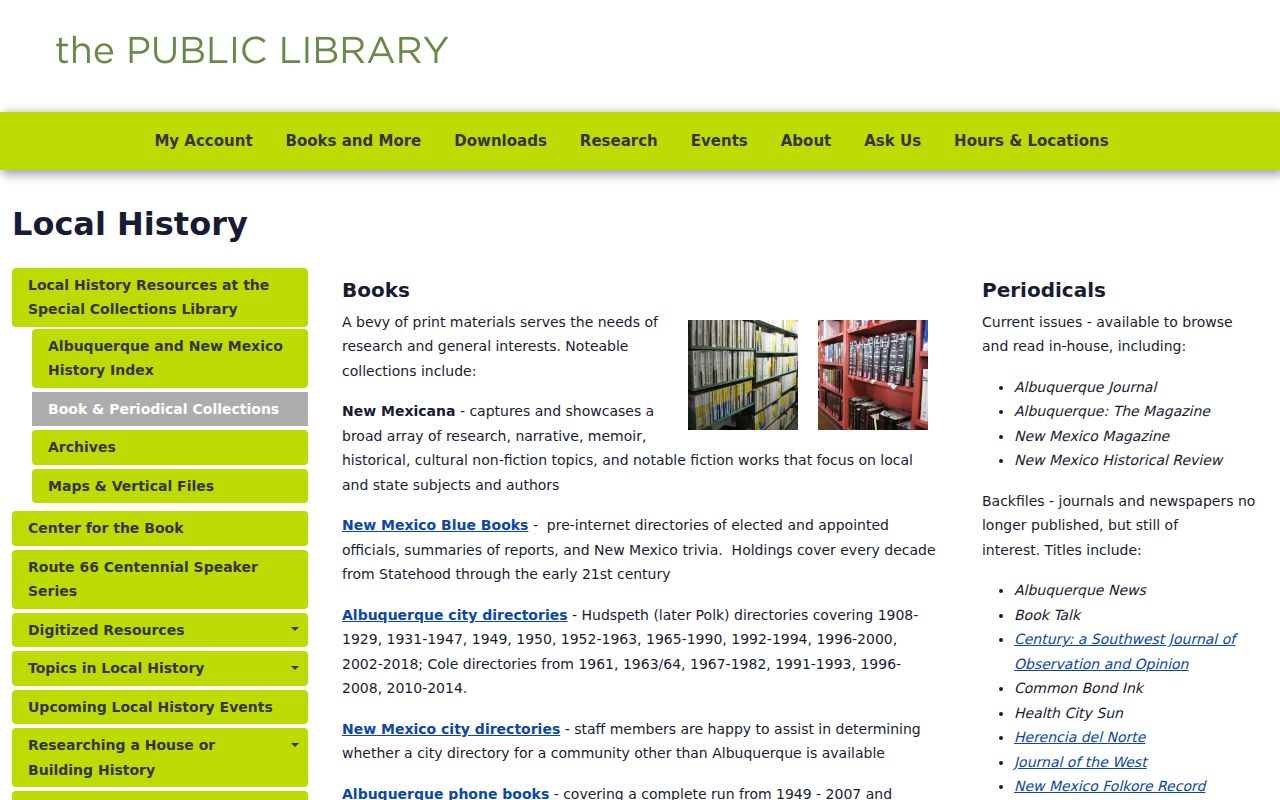
The screenshot shows the guide entry point, not a complete shelf inventory or a scanned directory page. Ask staff which years are present, whether the item is print or microfilm, whether remote access requires a library login, and whether a narrow lookup can be handled by the reference desk.
That last check matters because the guide's existence does not establish that every listed title is immediately available, open shelf, or digitized. Write down the city, year, surname, street spelling, and any suspected alternate name before requesting help. If the volume covers nearby suburbs or rural routes, note that boundary as well.
Reading a New Mexico City Directory Entry
A directory entry can combine a name, a street address, and a short note about a household or business. The exact page format depends on publisher and year. Research located a field checklist for inspecting an actual New Mexico volume, but no sample page image was accessible during the source review. The table below describes fields to look for in the book, not marks confirmed in every New Mexico edition.
| Field | What to Look For | Reading Caution |
|---|---|---|
| Name | Surname and given name, sometimes initials | Check spelling variants and initials in nearby years |
| Spouse or relationship | Parenthetical name or household notation where used | Publisher conventions vary; do not infer a relationship from an unexplained mark |
| Street address | House number and street name | Compare the printed year and city boundary with the modern parcel |
| Telephone number | A phone field in later volumes, where present | Do not assume that every volume includes a phone listing |
| Reverse section | An address-first list that points back to names | Listings may omit people or places outside the volume's coverage |
| Abbreviation key | Publisher's own short forms and symbols | Check the key for that edition before interpreting an unfamiliar mark |
- Criss-cross directory
- An address-first section that points from a street number to the name listed there. It can help when name spelling is uncertain.
- Householder index
- A name-first index to people or household heads included by that publisher. It is not a complete count of everyone at an address.
- Abbreviation key
- The book's own explanation of short forms and marks. Check it before reading a symbol as a relationship or status.
Start with the title page, publisher, edition year, library call number, and page number. Then capture the residential entry, any address-first page, and the key used to read its abbreviations. That record of where the fact came from makes a later comparison possible and prevents one publisher's shorthand from being carried into another book.
New Mexico Newspapers Between Directory Runs
A newspaper can help fill a gap between two directory years. Search notices tied to the street and surname: an obituary, wedding announcement, probate notice, business opening, school event, or civic item may connect a person to a place. The New Mexico Historic Newspapers collection and Chronicling America offer digitized titles, but their newspaper and year coverage varies. Local libraries may also hold microfilm that is not online.
Search New Mexico Historic Newspapers and check Chronicling America by title and date range. OCR can miss surnames, street names, accents, and broken type. Try a short surname, a second spelling, a street without its suffix, and a date range around the directory listing. When a result matters, inspect the page image and preserve the newspaper title, issue date, page, and archive record.
A newspaper mention can explain a move or family connection, but it does not replace the source record. Pair a notice with a directory page, probate file, cemetery record, or county deed according to the question. If no digital hit appears, ask the library whether the paper exists on microfilm and whether staff can search a focused date range.
New Mexico Maps Behind Old Directory Addresses
Old maps can bridge a printed address and a present-day street or parcel. UNM finding aids document an 1886 Albuquerque map and a detailed 1898 map showing city limits, plats, subdivisions, streets, blocks, businesses, railroad, and wards. The same research identifies Santa Fe maps from 1931 and 1936 and a statewide road map from 1933. These sources help explain where a directory's street sat in its own time, especially when a modern address label differs.
Explore the UNM Center for Southwest Research collections and finding aids for map, manuscript, newspaper, and local-history material.
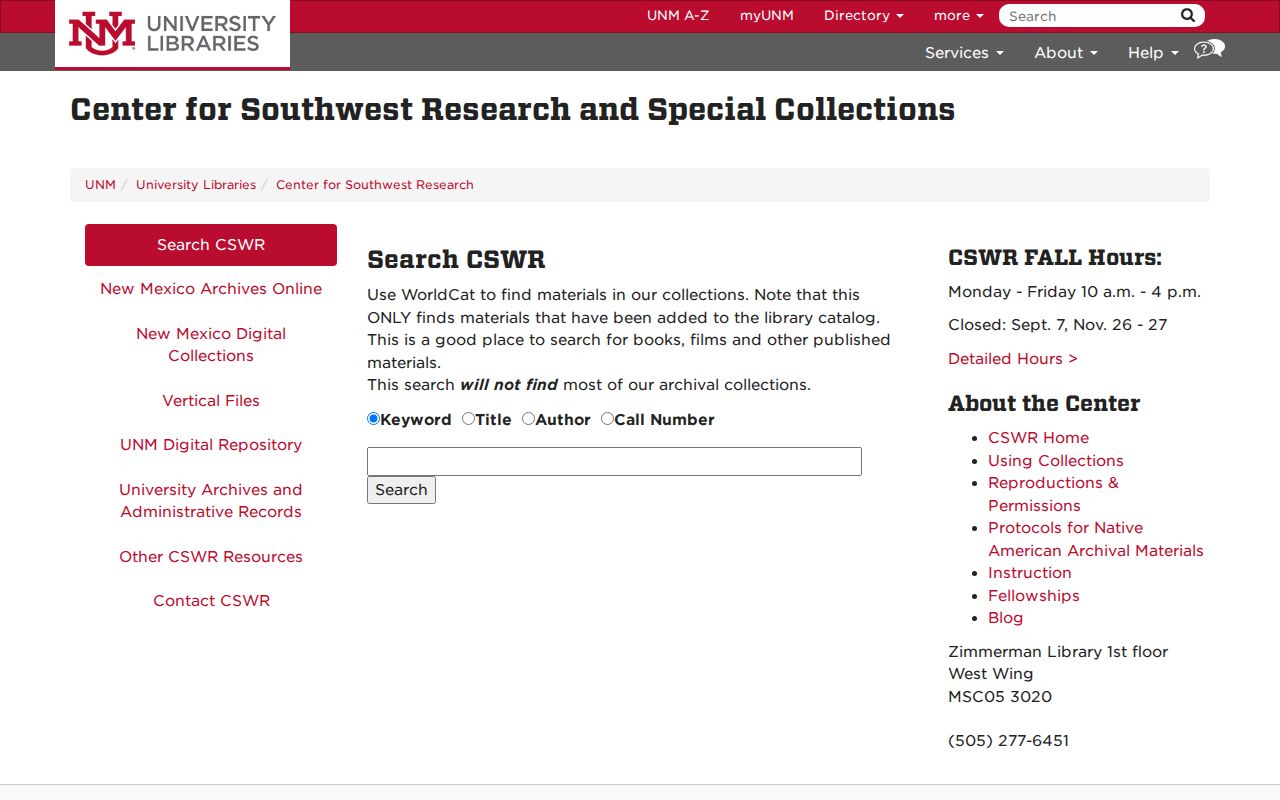
The image shows the Center's research entry point rather than one of the historic maps. Use the finding aid to identify a title or collection, then ask about reference access, image availability, or an appointment before relying on an unviewed map.
A map establishes geographic context, not the identity of an occupant or the legal boundary of a parcel. Use the county clerk's deed for the recorded legal description and a current county GIS or assessor record for the present parcel reference. A map label and a directory listing become more useful when the same lot, street segment, and year can be matched across sources.
New Mexico Directory Holdings at City Libraries
When a city directory is not online, the next stop is often a reference desk rather than a broad search engine. Ask the city library about print directories, phone books, yearbooks, obituaries, newspapers, local-history files, genealogy databases, and interlibrary loan. Staff may be able to check a narrow name-and-year question even when a database is available only inside the library. Give the city boundary and the exact volume year, since a county collection can include several towns or only an incorporated area.
The New Mexico State Records Center and Archives may hold transferred state records and finding aids. UNM's Center for Southwest Research has statewide maps, manuscripts, vertical files, photographs, newspapers, and local-history material. Historical societies, county museums, parish archives, cemetery offices, schools, and community organizations can preserve records that county indexes do not contain. Their dates, name indexing, and access conditions differ, so ask before assuming that a roster or register can be viewed.
Use the New Mexico MainStreet house-history checklist to connect directory research with probate, maps, physical building evidence, and oral history. For a current parcel or title question, return to the county assessor and clerk rather than treating an archive listing as a present-day record.
Tracing New Mexico Families Across Directory Years
To follow a family, build a dated trail rather than relying on one entry. Use one year before and after the target volume when both are available. Keep the address exactly as printed, along with a possible spouse or relationship mark and the abbreviation key. The process below pairs local listings with sources that cover different years and questions.
- Search the person's surname in the target city and year, then check the closest available volume on either side.
- Copy the entry and page details, including street number, street spelling, household notation, and telephone field if present.
- Check an address-first section for the same year to find a listing missed by a surname search.
- Pair the directory year with the nearest available federal census schedule, keeping in mind that the census date and publication year differ.
- Follow the same address or family name in the next directory run; use maps and street records if the label or number changed.
- Verify a recent property link through the county assessor or deed, and use probate, obituary, or cemetery evidence to clarify an older family trail.
Individual federal census schedules are released under the 72-year rule, and the research identifies 1790-1950 as the released range. A census and a directory are not interchangeable: one records a household at census time, while the other follows a publisher's inclusion and city boundary. Compare names, ages or relationships where shown, address, and year rather than expecting an exact match between every line.
If a person disappears from one directory, several explanations remain possible: a move, a changed spelling, a gap in publication, a changed city boundary, or omission by the publisher. Search a nearby street number, an alternate surname, and the next surviving year before drawing a conclusion. Use the proper custodian to confirm a legal or vital fact.
New Mexico Directories as Historical Records
A printed directory is an index to the names and addresses its publisher chose to include, not a complete roll of the state or a live record of current residents. A telephone directory may list subscribers only. A business directory can use a shop or main office, and a reverse volume may omit institutions, private numbers, rural routes, or people outside its city boundary. The printed year may describe a publication period that spans two calendar years.
Use an old entry as a lead, then test it against a second source that fits the date. A local newspaper can add a notice; a map can clarify an old street; probate may identify an estate connection; a county deed establishes a recorded transfer. None of those records alone supplies every detail about a person. Keep the source, date, and uncertainty with each step so that a name match is not mistaken for proof.
For a modern address trail, consult the New Mexico street directory page for current assessor, GIS, and deed-search methods. When the goal is to verify one living person's identity across official records, the New Mexico resident lookup is more appropriate than stretching an old volume beyond its purpose.